Aeroponics and the contribution to increase potato crops on earth and space. interview with Richard Stoner, Founder & President AgriHouse Inc along leading scientists. NASA funded aeroponic research and development.
Showing posts with label hydroponics. Show all posts
Showing posts with label hydroponics. Show all posts
Saturday, May 14, 2011


Sunday, May 8, 2011
Formula nutrient solutions for hydroponics
Formula Tumanov 1960 year
Macroelements
| pH | Ca++ | Mg++ | Na+ | K+ | NH4+ | NO3- | PO4- | SO4= | Cl- |
| 6-7 | 300 | 50 | - | 150 | - | 100 | 80 | 64 | 4 |
Microelements
| Fe | Mn | Cu | Zn | B | Mo |
| 2 | 0,5 | 0,05 | 0,1 | 0,5 | 0,02 |
Formula Kidson
Macroelements
| pH | Ca++ | Mg++ | Na+ | K+ | NH4+ | NO3- | PO4- | SO4= | Cl- |
| 5,5 | 340 | 54 | 35 | 234 | - | 208 | 57 | 114 | 75 |
Microelements
| Fe | Mn | Cu | Zn | B | Mo |
| 2 | 0,25 | 0,05 | 0,05 | 0,5 | 0,1 |
Formula Purdue
Macroelements
| pH | Ca++ | Mg++ | Na+ | K+ | NH4+ | NO3- | PO4- | SO4= | Cl- |
| - | 200 | 96 | - | 390 | 28 | 70 | 63 | 607 | - |
Microelements
| Fe | Mn | Cu | Zn | B | Mo |
| 20 | 0,3 | 0,02 | 0,05 | 0,5 | - |
Formula Schwartz Israel
Macroelements
| pH | Ca++ | Mg++ | Na+ | K+ | NH4+ | NO3- | PO4- | SO4= | Cl- |
| - | 124 | 43 | - | 312 | - | 98 | 93 | 160 | - |
Microelements
| Fe | Mn | Cu | Zn | B | Mo |
| - | - | - | - | - | - |
Formula Schwartz California
Macroelements
| pH | Ca++ | Mg++ | Na+ | K+ | NH4+ | NO3- | PO4- | SO4= | Cl- |
| - | 160 | 48 | - | 200 | 15 | 196 | 31 | 147 | - |
Microelements
| Fe | Mn | Cu | Zn | B | Mo |
| - | - | - | - | - | - |
Formula Schwartz New Jersey
Macroelements
| pH | Ca++ | Mg++ | Na+ | K+ | NH4+ | NO3- | PO4- | SO4= | Cl- |
| - | 180 | 55 | - | 90 | 20,5 | 126 | 71 | 96 | - |
Microelements
| Fe | Mn | Cu | Zn | B | Mo |
| - | - | - | - | - | - |
Formula Schwartz South Africa
Macroelements
| pH | Ca++ | Mg++ | Na+ | K+ | NH4+ | NO3- | PO4- | SO4= | Cl- |
| - | 210 | 50 | - | 300 | - | 200 | 65 | - | - |
Microelements
| Fe | Mn | Cu | Zn | B | Mo |
| - | - | - | - | - | - |
Formula CDA A
Macroelements
| pH | Ca++ | Mg++ | Na+ | K+ | NH4+ | NO3- | PO4- | SO4= | Cl- |
| - | 131 | 22 | - | 209 | 33 | 93 | 36,7 | 29,5 | 188 |
Microelements
| Fe | Mn | Cu | Zn | B | Mo |
| 1,7 | 0,8 | 0,035 | 0,094 | 0,46 | 0,027 |
Formula CDA В Saanichton
Macroelements
| pH | Ca++ | Mg++ | Na+ | K+ | NH4+ | NO3- | PO4- | SO4= | Cl- |
| - | 146 | 22 | - | 209 | 33 | 135 | 36,7 | 29,5 | 108 |
Microelements
| Fe | Mn | Cu | Zn | B | Mo |
| 1,7 | 0,8 | 0,035 | 0,094 | 0,46 | 0,027 |
Formula CDA С Canada
Macroelements
| pH | Ca++ | Mg++ | Na+ | K+ | NH4+ | NO3- | PO4- | SO4= | Cl- |
| - | 146 | 22 | - | 209 | 33 | 177 | 36,7 | 29,5 | - |
Microelements
| Fe | Mn | Cu | Zn | B | Mo |
| 1,7 | 0,8 | 0,035 | 0,094 | 0,46 | 0,027 |
Formula Dr. Pilgrim
Macroelements
| pH | Ca++ | Mg++ | Na+ | K+ | NH4+ | NO3- | PO4- | SO4= | Cl- |
| - | 272 | 54,3 | - | 400 | - | 143,4 | 93 | 237,5 | - |
Microelements
| Fe | Mn | Cu | Zn | B | Mo |
| - | - | - | - | - | - |
Formula Dr. Pilgrim Elizabeth
Macroelements
| pH | Ca++ | Mg++ | Na+ | K+ | NH4+ | NO3- | PO4- | SO4= | Cl- |
| - | 204 | 40,7 | - | 300 | - | 107,6 | 69,75 | 178,1 | - |
Microelements
| Fe | Mn | Cu | Zn | B | Mo |
| - | - | - | - | - | - |
Formula Dr. Pilgrim USA
Macroelements
| pH | Ca++ | Mg++ | Na+ | K+ | NH4+ | NO3- | PO4- | SO4= | Cl- |
| - | 136 | 27,15 | - | 200 | - | 71,7 | 46,5 | 118,75 | - |
Microelements
| Fe | Mn | Cu | Zn | B | Mo |
| - | - | - | - | - | - |
Formula Dr. Resh
Macroelements
| pH | Ca++ | Mg++ | Na+ | K+ | NH4+ | NO3- | PO4- | SO4= | Cl- |
| - | 197 | 44 | - | 400 | 30 | 145 | 65 | 197,5 | - |
Microelements
| Fe | Mn | Cu | Zn | B | Mo |
| 2 | 0,5 | 0,03 | 0,05 | 0,5 | 0,02 |
Formula Dr. Resh University B.C.
Macroelements
| pH | Ca++ | Mg++ | Na+ | K+ | NH4+ | NO3- | PO4- | SO4= | Cl- |
| - | 148 | 33 | - | 300 | 20 | 110 | 55 | 144,3 | - |
Microelements
| Fe | Mn | Cu | Zn | B | Mo |
| 2 | 0,5 | 0,03 | 0,05 | 0,5 | 0,02 |
Formula Dr. Resh Vancouver 1971 year
Macroelements
| pH | Ca++ | Mg++ | Na+ | K+ | NH4+ | NO3- | PO4- | SO4= | Cl- |
| - | 98,5 | 22 | - | 200 | 10 | 80 | 40 | 83,2 | - |
Microelements
| Fe | Mn | Cu | Zn | B | Mo |
| 2 | 0,5 | 0,03 | 0,05 | 0,5 | 0,02 |
Formula Dr. Resh tropics, dry season, lettuce 1984 year
Macroelements
| pH | Ca++ | Mg++ | Na+ | K+ | NH4+ | NO3- | PO4- | SO4= | Cl- |
| - | 250 | 36 | - | 200 | 53 | 177 | 60 | 129 | - |
Microelements
| Fe | Mn | Cu | Zn | B | Mo |
| 5 | 0,5 | 0,03 | 0,05 | 0,5 | 0,02 |
Formula Dr. Resh tropics during the rainy season, lettuce 1984 year
Macroelements
| pH | Ca++ | Mg++ | Na+ | K+ | NH4+ | NO3- | PO4- | SO4= | Cl- |
| - | 150 | 50 | - | 150 | 32 | 115 | 50 | 52 | - |
Microelements
| Fe | Mn | Cu | Zn | B | Mo |
| 5 | 0,5 | 0,03 | 0,05 | 0,5 | 0,02 |
Formula Dr. Resh California, lettuce 1989-1993 year
Macroelements
| pH | Ca++ | Mg++ | Na+ | K+ | NH4+ | NO3- | PO4- | SO4= | Cl- |
| - | 200 | 40 | - | 210 | 25 | 165 | 50 | 113 | - |
Microelements
| Fe | Mn | Cu | Zn | B | Mo |
| 5 | 0,5 | 0,1 | 0,1 | 0,5 | 0,05 |
Formula Dr. Resh Florida, cucumber (0-10 days) 1990 year
Macroelements
| pH | Ca++ | Mg++ | Na+ | K+ | NH4+ | NO3- | PO4- | SO4= | Cl- |
| - | 100 | 20 | - | 175 | 3 | 128 | 27 | 26 | - |
Microelements
| Fe | Mn | Cu | Zn | B | Mo |
| 2 | 0,8 | 0,07 | 0,1 | 0,3 | 0,03 |
Formula Dr. Resh Florida cucumbers at 10-day before the first ovary
Macroelements
| pH | Ca++ | Mg++ | Na+ | K+ | NH4+ | NO3- | PO4- | SO4= | Cl- |
| - | 220 | 40 | - | 350 | 7 | 267 | 55 | 53 | - |
Microelements
| Fe | Mn | Cu | Zn | B | Mo |
| 3 | 0,8 | 0,07 | 0,1 | 0,3 | 0,03 |
Formula Dr. Resh Florida, the further growth of cucumber
Macroelements
| pH | Ca++ | Mg++ | Na+ | K+ | NH4+ | NO3- | PO4- | SO4= | Cl- |
| - | 200 | 45 | - | 400 | 7 | 255 | 55 | 82 | - |
Microelements
| Fe | Mn | Cu | Zn | B | Mo |
| 2 | 0,8 | 0,1 | 0,33 | 0,4 | 0,05 |
The methods of growing comercial hydroponic lettuce.
Short film about growing lettuce in industrial quantities
Thursday, May 5, 2011
Aeroponic system
 |
| Aeroponic system |
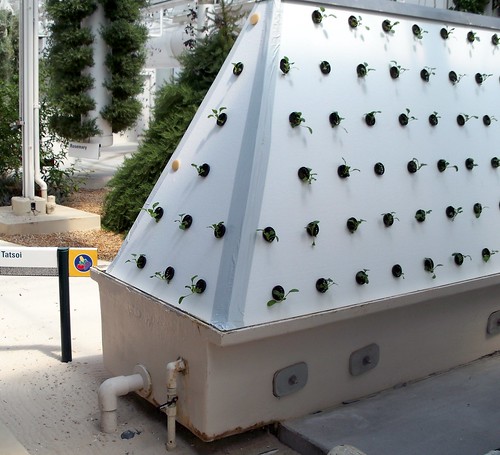
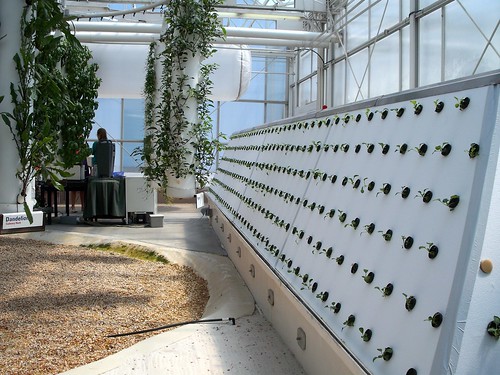
A timer controls the nutrient pump much like other types of hydroponic systems, except the aeroponic system needs a short cycle timer that runs the pump for a few seconds every couple of minutes.
N.F.T. system (Nutrient Film Technique)
 | |
| NFT system |
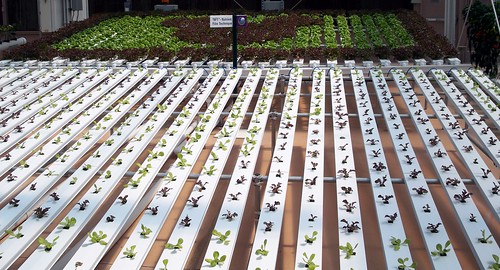
There is usually no growing medium used other than air, which saves the expense of replacing the growing medium after every crop. Normally the plant is supported in a small plastic basket with the roots dangling into the nutrient solution.
N.F.T. systems are very susceptible to power outages and pump failures. The roots dry out very rapidly when the flow of nutrient solution is interrupted.
Drip systems (recovery / non-recovery)
Drip systems are probably the most widely used type of hydroponic system in the world. Operation is simple, a timer controls a submersed pump. The timer turns the pump on and nutrient solution is dripped onto the base of each plant by a small drip line. In a Recovery Drip System the excess nutrient solution that runs off is collected back in the reservoir for re-use. The Non-Recovery System does not collect the run off.
A recovery system uses nutrient solution a bit more efficiently, as excess solution is reused, this also allows for the use of a more inexpensive timer because a recovery system doesn't require precise control of the watering cycles. The non-recovery system needs to have a more precise timer so that watering cycles can be adjusted to insure that the plants get enough nutrient solution and the runoff is kept to a minimum.
The non-recovery system requires less maintenance due to the fact that the excess nutrient solution isn't recycled back into the reservoir, so the nutrient strength and pH of the reservoir will not vary. This means that you can fill the reservoir with pH adjusted nutrient solution and then forget it until you need to mix more. A recovery system can have large shifts in the pH and nutrient strength levels that require periodic checking and adjusting.
 |
| Drip systems |
The non-recovery system requires less maintenance due to the fact that the excess nutrient solution isn't recycled back into the reservoir, so the nutrient strength and pH of the reservoir will not vary. This means that you can fill the reservoir with pH adjusted nutrient solution and then forget it until you need to mix more. A recovery system can have large shifts in the pH and nutrient strength levels that require periodic checking and adjusting.
EBB & FLOW system - (flood and drain)
EBB & FLOW system |

The Ebb and Flow system works by temporarily flooding the grow tray with nutrient solution and then draining the solution back into the reservoir. This action is normally done with a submerged pump that is connected to a timer.
When the timer turns the pump on nutrient solution is pumped into the grow tray. When the timer shuts the pump off the nutrient solution flows back into the reservoir. The Timer is set to come on several times a day, depending on the size and type of plants, temperature and humidity and the type of growing medium used.
The Ebb & Flow is a versatile system that can be used with a variety of growing mediums. The entire grow tray can be filled with Grow Rocks, gravel or granular Rockwool. Many people like to use individual pots filled with growing medium, this makes it easier to move plants around or even move them in or out of the system. The main disadvantage of this type of system is that with some types of growing medium (Gravel, Growrocks, Perlite), there is a vulnerability to power outages as well as pump and timer failures. The roots can dry out quickly when the watering cycles are interrupted. This problem can be relieved somewhat by using growing media that retains more water (Rockwool, Vermiculite, coconut fiber or a good soiless mix like Pro-mix or Faffard's).
Water culture system
 |
| Water culture system |
Water culture is the system of choice for growing leaf lettuce, which are fast growing water loving plants, making them an ideal choice for this type of hydroponic system. Very few plants other than lettuce will do well in this type of system.
This type of hydroponic system is great for the classroom and is popular with teachers. A very inexpensive system can be made out of an old aquarium or other water tight container. We have free plans and instructions for a simply water culture system.
The biggest draw back of this kind of system is that it doesn't work well with large plants or with long-term plants.
Wick system
 |
| Wick system |
This system can use a variety of growing medium. Perlite, Vermiculite, Pro-Mix and Coconut Fiber are among the most popular.
The biggest draw back of this system is that plants that are large or use large amounts of water may use up the nutrient solution faster than the wick(s) can supply it.
Aquaponics system
 For those who are interested, there are many sites that provide good information regarding this technique of having fish, and also growing your own plants.
However I will endeavour to break it down into a simplified way for the beginner to understand. I do not profess to be a guru on this subject and am quite prepared to stand corrected should I be wrong.
If you have ever had aquariums or small fish tanks, then you will be aware that there was/is a need to change at least a third of the water every couple of weeks. This is due to the build up of ammonia in the water from the fish excretia. Too much ammonia in the water becomes toxic to the fish and they die, so by removing a third and replenishing it with fresh water you are creating a balance for the fish to survive.
Aquaponics works on the same principle. I have created a life cycle diagram to try and simplify the basic concept of how aquaponics work without getting too technical.
The fish having been fed, in due course give off excrement which eventually builds up in the water as ammonia.
There are two types of bacteria required to convert the ammonia. The first; converts the ammonia into nitrites and the 2nd converting the nitrites into nitrates (nitrogen) which is a source required by plants.
The plants take up the water and nutrients within it. What is not taken up by the plants is returned back to the tank via a bio-filter. This filter removes any unused solids and cleans the water before it returns back into the fish tank.
source: geelonghydroponicgardening.com
"Aquaponics Made Easy" - the video will be watched how to be growing plants and to farmed fish. System what use in video is "EBB & FLOW system"


Subscribe to:
Posts (Atom)
Popular Posts
-
Formula Tumanov 1960 year Macroelements pH Ca ++ Mg ++ Na + K + NH4 + NO3 - PO4 - SO4 = Cl - 6-7 300 50 - 150 - 100 8...
-
Aeroponics and the contribution to increase potato crops on earth and space. interview with Richard Stoner, Founder & President AgriHo...
-
Drip systems are probably the most widely used type of hydroponic system in the world. Operation is simple, a timer controls a submersed ...
-
This book is a comprehensive and practical guide to soilless growing. It is known as the Bible of the industry. It is a methods book in that...
-
LED lights for plants growing Grow lights are usually used for indoor gardening, plant propagation and food production, including indoor...
-
For those who are interested, there are many sites that provide good information regarding this technique of having fish, and also growing...
-
Aeroponic system The aeroponic system is probably the most high-tech type of hydroponic gardening. Like the N.F.T. system above the g...
-
Learn the techniques of successful plant propogation and avoid mistakes and disappointments with expert advice from Lewis Hill. Grow beautif...
-
where a H + is the activity of hydrogen ions in units of mol/L (molar concentration) pH is a measure of the acidity or basicity of an aqu...


